The Church Has Always Hated Its Own New Music
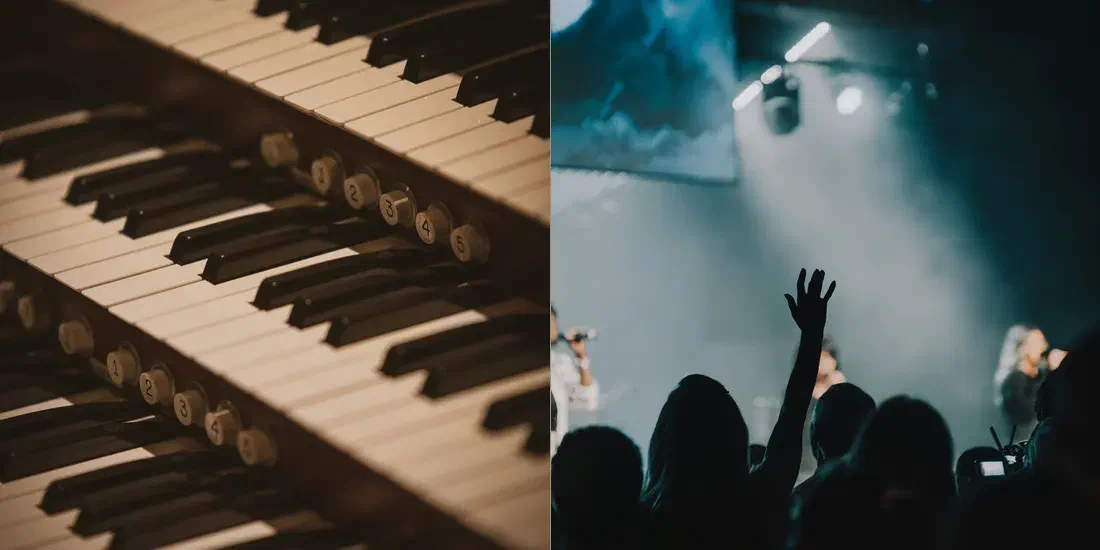
Before you read another think-piece about whether Hillsong lyrics are theologically shallow, or whether electric guitars have any business in a sanctuary, consider this:
Somewhere in Scotland in 1873, a woman stood up in the middle of a church service, pushed past the people in her pew, and fled toward the exit. As she went, she shouted over her shoulder at the singer on the platform:
“Let me oot! Let me oot! What would John Knox think of the like of yon?”
The offensive sound she was escaping? A man named Ira Sankey, singing a simple gospel hymn to his own accompaniment on a small cabinet organ. Critics called it his “kist o’ whistles,” a chest of whistles, and they were convinced there was a devil in every pipe.
That woman thought she was defending the ancient faith. She was actually defending music that had itself been considered dangerously new within living memory of her parents.
This is the story of the church and its music. It has been the same story, with different instruments, for nearly two thousand years.
The Sentence That Keeps Getting Said
Run through the following complaints and see if you can guess which era they’re from:
“It appeals to the emotions, not the mind.”
“It borrows from worldly, even pagan, sources.”
“It is sensual and appeals to the flesh.”
“The old music was divinely inspired. This new music is man-made.”
“It will lead to moral decline.”
“It is a Trojan horse smuggling error into the church.”
The answer to all of them is: every era. Every single one. These exact criticisms, sometimes in nearly identical language, have been leveled against every major shift in Christian worship music for almost two millennia. The specific target changes. The complaint doesn’t.
Era 1: The Early Church Bans Everything (100–1200 AD)
The earliest Christian worship had no instruments at all. This was not an accident or a poverty of resources. It was theology.
The church fathers viewed instruments as connected to pagan ritual, to theater, and to the sensual practices they were trying to separate themselves from. Pope Clement I put it plainly: “Leave the flute to the shepherds; leave the flute to those who fear the gods and worship idols.”
This was not a fringe position. It held for over a thousand years. The Roman Catholic Church didn’t formally adopt instruments until around the 13th century, and even then it encountered strong opposition and made its way slowly to general acceptance. Thomas Aquinas, writing in the 1200s, described the prevailing practice this way: “Our church does not use musical instruments, as harps and psalteries, to praise God withal, that she may not seem to Judaize.”
File that sentence away. We will hear it again.
Era 2: The Reformers Draw the Line at the Organ (1520s–1600s)
When the Protestant Reformation swept Europe, the Reformers didn’t just reject Catholic doctrine. They rejected Catholic music.
John Calvin was precise about his reasons. Instruments, he argued, “were among the legal ceremonies which Christ at His coming abolished.” To use them in worship was to drag the church backward into the shadow world of the Old Testament. He wrote: “Musical instruments in celebrating the praises of God would be no more suitable than the burning of incense, the lighting up of lamps, and the restoration of the other shadows of the law. The papists, therefore, have foolishly borrowed this, as well as many other things, from the Jews.”
Peter Martyr Vermigli summarized it even more sharply: “Musical organs pertain to the Jewish ceremonies and agree no more to us than circumcision.”
Even Martin Luther, who loved music passionately and wrote hymns himself, reportedly called the organ in worship “a sign of Baal.”
The Calvinist churches acted. In 1525, Zurich’s city authorities ordered the organ of the Great Minster broken to pieces. The 1574 Synod of Dort concluded that organs should be rejected outright. By 1578, the National Synod of Dort was trying to remove instruments from all Dutch Reformed churches. As late as 1727, only one organ could be found in all the churches of Scotland.
The thing they were defending against (instruments borrowed from unbelievers, bypassing the mind to appeal to the senses) sounds familiar. We will hear it again.
Era 3: The Singing Wars: Are Human Voices Even Allowed? (1640s–1690s)
While Calvinists were fighting over instruments, an even more basic dispute was raging: whether congregations should sing at all, and if so, what.
The strict position held that only the inspired Psalms of David were acceptable for worship. Any other text, no matter how doctrinally sound, was a “human hymn,” and therefore an intrusion of man’s wisdom into a space reserved for God’s alone.
When the Baptist pastor Benjamin Keach introduced congregational hymn singing at his Southwark chapel in the 1670s, it split his congregation. His colleague Isaac Marlow published A Discourse Concerning Singing (1690), arguing that singing was a distraction from true worship. Congregations literally divided into “singing churches” and “non-singing ones.”
Cotton Mather, the famous New England Puritan, offered a warning about where this permissiveness might lead: if organs were admitted to the church, other instruments would eventually follow, and then dancing would come after that.
He said this about organs. He was predicting the slippery slope in 1700. You will recognize the argument.
Era 4: Isaac Watts and His Dangerous “Flights of Fancy” (1707–1749)
By 1707, Isaac Watts had grown so frustrated with the state of congregational singing in English dissenting churches that he decided to do something about it. What he did was write new songs that went beyond the Psalms, songs that expressed Christian devotion in the vernacular of his own day, that centered on the experience of the believer and the person of Jesus.
We know these songs as hymns. We call them “the old hymns.” At the time, they were considered a radical and dangerous innovation.
His critics had a specific grievance: these were man-made songs. Not inspired Scripture. The Reverend William Romaine, rector of St. Anne’s, Blackfriars, attacked congregations that would “shut out the divinely inspired psalms and take in Dr. Watt’s flights of fancy.”
One critic demanded: “Does Dr. Watts indeed presume to correct and instruct the Holy Ghost in writing Psalms?”
Watts’ hymns were also accused of being too focused on human experience, too emotional, too subjective. More about how the singer felt than about the objective truth of God. They were, in other words, man-centered. The same phrase would be used against contemporary worship music almost exactly 300 years later.
It was at least 40 years after Watts’ death before some American churches would consent to sing his hymns. The songs he wrote, “Joy to the World,” “When I Survey the Wondrous Cross,” “O God Our Help in Ages Past,” are now the definition of traditional worship music. They were once evidence of theological compromise.
Era 5: Handel’s Messiah Condemned as a “Religious Farce” (1741)
George Frideric Handel composed his Messiah in 1741. It premiered in Dublin to immediate popular success. When it came to London, the response from the church was sharply different.
Anglican clergy were outraged that sacred Scripture was being performed on a theater stage by professional singers. One critic wrote: “An oratorio either is an act of religion or it is not; if it is, I ask if the playhouse is a fit temple to perform it in, or a company of players fit ministers of God’s Word?”
The Dean of St. Patrick’s Cathedral, Jonathan Swift, author of Gulliver’s Travels, threatened any of his clergy who participated, denouncing them as “songsters, fiddlers, pipers, trumpeters, drummers, drum-majors, or in any sonal quality.”
The Messiah was not performed in a church until 18 years after it was composed.
In 1784, when a massive London festival celebrated Handel with a 500-piece performance at Westminster Abbey, the famed pastor John Newton, author of “Amazing Grace,” was so troubled that he preached more than 50 sermons in response. His concern was not the music itself, but how it was heard: as entertainment, in a secular venue, by people who had no interest in the God it described. He called such performances “no better than a profanation of the name and truths of God.”
Notice the complaint is beginning to evolve. It is no longer just about instruments or texts. It is about worldliness. About the music attracting the wrong kind of people for the wrong reasons. About spectacle substituting for genuine worship.
We will hear this again.
Era 6: The Organ Comes for the Presbyterians (1807–1914)
When William Ritchie introduced a chamber organ into St. Andrew’s Church, Glasgow in 1807, doing for Presbyterians what the Catholics had done 600 years earlier. The Lord Provost of the city reported the matter to the presbytery, which declared organ music “contrary to the law of the land, and to the law and constitution of our Established Church.”
The organ debate burned through Presbyterian and Baptist churches for most of the 19th century. Presbyterian theologian R.L. Dabney dismissed it as “this Popish mode of worship” in 1849, and argued that the organ was “utterly unsuited, ill-judged, and in ill taste” as an accompaniment for Protestant worship. Not for reasons of personal preference, but because it overwhelmed the articulation of words, which were the entire point.
The Southern Presbyterian theologian Dr. Girardeau called instrumental accompaniment “heresy in the sphere of worship” and charged that “a sin it is… The people ought to be taught that in using it they rebel against the law of Christ, their King.”
Baptist historian David Benedict wrote mournfully: “Staunch old Baptists in former times would as soon tolerated the Pope of Rome in their pulpits as an organ in their galleries, and yet the instrument has gradually found its way among them.”
In 1914, the year the First World War began, the Reformed Presbyterian Synod was still formally ruling that musical instruments were “inherently symbolic and emotive” and must be eliminated from worship. This was not a medieval position. It was recent enough that your great-great-grandparents were alive for it.
Era 7: “Kist o’ Whistles”: Moody, Sankey, and the Human Hymn (1873–1875)
When American evangelist Dwight L. Moody and his singer Ira Sankey arrived in Scotland for their 1873 revival tour, they walked into a theological minefield they had not fully anticipated.
Scottish Presbyterians had a simple liturgical tradition: they sang the Psalms. Only the Psalms. In the version approved by the church. Unaccompanied. Anything else was a “human hymn,” the work of uninspired men, and had no place in the worship of God.
Sankey sang gospel songs. He accompanied himself on a small cabinet organ. The Scottish called the organ his “kist o’ whistles,” a chest of whistles, and believed there was a devil in each pipe.
The scene at Edinburgh became famous. Sankey had just begun a solo when a woman’s voice rang from the gallery as she pushed toward the exit: “Let me oot! Let me oot! What would John Knox think of the like of yon?”
After one meeting, a troubled Scotsman visited his pastor and confessed his distress: “I cannot do with those hymns. They are all the time in my head, and I cannot get them out. The Psalms never trouble me that way.” His pastor replied: “Very well, then, I think you should keep the hymns.”
A prominent minister warned Moody that if Sankey kept singing such rhythmic, emotional songs, “he would have them all dancing.”
Critics charged that the revival owed more to Sankey’s music than to the Holy Spirit, that it was “more the work of fleshly excitement than of the Holy Spirit.” The music, they said, was manipulating emotions. Creating artificial experiences. Drawing crowds for the wrong reasons.
These are now called “the great old gospel hymns.” They are what contemporary worship music is often measured against.
Era 8: The Salvation Army Steals the Devil’s Tunes (1878–1900s)
When William Booth launched the Salvation Army, he needed to reach people the established church was not reaching: working-class Londoners, people who lived in pubs and music halls, people who would never walk through the door of a proper church. His solution was to take their music and turn it against the darkness.
Booth said it plainly: “I rather enjoy robbing the devil of his choicest tunes.” Popular music-hall songs were given new Christian lyrics and played on brass instruments in the streets. The Army’s approach was direct: use whatever music the people already know and love, because the spiritual power is in the words, not the tunes.
The established churches were resentful of what they saw as a challenge to their traditional way. A correspondent wrote in 1884 that the Salvation Army’s music was “primarily a bait to catch the common throng” using ear-catching tunes the people already knew from music halls and street organs.
The criticism followed a pattern now familiar: Booth was borrowing from sinners. The tunes were worldly. The brass bands were festive and emotional, more appropriate to a parade than a prayer meeting. The church was being brought down to the level of the street.
Booth’s own ambivalence is instructive. He was suspicious of music’s “seductive power” and worried that bands would gain an independent identity, that music would become performance, that spectacle would displace sincerity. He famously warned about choirs: “I have ever found choirs to be possessed of three devils, awkward, ugly and impossible to cast out. They are the quarrelling devil, the dressing devil, and the courting devil, and the last is the worst of the three.”
He solved this by co-opting popular music before it could co-opt him. Whether it worked is a question still being debated.
Era 9: “Why Should the Devil Have All the Good Music?” (1969–1980s)
In 1969, a young Californian named Larry Norman released Upon This Rock, now considered the first Christian rock album. The church’s response was swift and largely negative.
Norman’s biographer summarizes it clearly: “The church absolutely hated what he was doing because they thought that rock and roll was the devil’s music.” His Capitol Records debut was deemed a commercial flop and Norman was dropped from the label. Television evangelists denounced him. Fundamentalist pastors labeled him everything from a Catholic spy to a Jesuit infiltrator.
In 1972, Norman addressed the controversy directly in a song titled “Why Should the Devil Have All the Good Music?” It was essentially Booth’s argument, set to a rock beat.
The critics were organized and specific. They argued that rock music’s rhythm was “borrowed from pagan cultures” and permanently associated with immorality. That it “appealed to the flesh, not the spirit.” That its “chief appeal was to the heels instead of the head.” One fundamentalist publication labeled it the “jungle beat,” a phrase laden with its own history of ugliness. CCM was called “the new Trojan Horse of Modernism” (the same phrase used against Isaac Watts’ hymns 250 years earlier.
Bob Jones University banned CCM from dormitories. Frank Garlock declared at BJU in 2001: “If a church starts using CCM, it will eventually lose all other standards.”
Meanwhile, Cliff Richard, one of the first British rock stars to publicly identify as a Christian, recalled the cultural pressure: “There was a feeling that rock and roll and church didn’t go together… I remember reading of Christian fundamentalist preachers in America burning rock and roll records and thinking: ‘Oh, my goodness, that’s me!’”
Norman himself never escaped the position he articulated so well: too rock-and-roll for the religious people, and too religious for the rock-and-roll people. He spent the last years of his life deeply critical of what the Christian music industry had become: one more person defending yesterday’s music against today’s.
Era 10: “7/11 Music” and the Hillsong Problem (2000s–Present)
The contemporary worship wars require less historical excavation, because many readers are living through them.
The criticisms are now well-rehearsed: Hillsong, Bethel, and Elevation write music that is theologically shallow. It is emotionally manipulative. It prioritizes experience over doctrine. It is “7/11 music” (seven words sung eleven times) engineered to create a mood rather than convey truth. It borrows production techniques and sonic aesthetics from secular pop music. It attracts people who like the music rather than people who believe the theology. It is a pipeline to dangerous ministries.
Christianity Today summarized the concern: “Worship music can move and manipulate emotions, even shape belief.”
The most striking thing about this critique is not that it’s wrong. Some of it may be entirely right. The most striking thing is that it is indistinguishable, word for word, from what was said about gospel hymns in 1873 Scotland. And what was said about Watts’ hymns in 1720. And what was said about the organ in 1807. And what was said about the Messiah in 1741.
The formula is always the same:
- The old music is divinely sanctioned.
- The new music is borrowed from the world.
- The new music bypasses the mind to manipulate the emotions.
- The new music will lead to moral and theological decline.
- The people defending the new music are naive, worldly, or in the enemy’s pay.
Every generation inherits yesterday’s controversy as its orthodoxy, and then applies the same template to whatever comes next.
This matters for how we think about everything in worship, from whether the music is too loud to what worship actually is.
The Through-Line
Here is what makes this history so strange, and so clarifying:
The woman who fled Ira Sankey’s Edinburgh meeting in 1873, shouting “What would John Knox think?!” She was defending music that Knox himself would have banned. The Psalms she loved were sung in a version approved by the church, accompanied by nothing, as Knox intended. But she considered them ancient and untouchable.
The Baptist deacon who told his son that the church’s old Psalm tunes were “good enough for your grandfather, your father, and so I reckon it will have to be good enough for you.” He was defending music that an earlier generation had condemned as insufficiently rigorous.
The Reformation-era Calvinist who smashed the organ at Zurich. He was defending a cappella worship from an instrument that the Catholics had only recently introduced over enormous opposition.
In each case, the line between “sacred tradition” and “dangerous novelty” is exactly one generation.
The reformers of one era become the gatekeepers of the next. The “old hymns” that contemporary worship is measured against were once the contemporary worship that the old hymns were measured against.
This is not an argument that musical discernment doesn’t matter. It is not a claim that all music is equally valid for worship. The debates within these eras often engaged real theological substance, and reasonable people landed in different places.
It is, however, an argument for humility. Before declaring that the current controversy is uniquely serious, uniquely threatening, and uniquely the result of worldly compromise. It is worth knowing that every generation has said exactly that. About music that is now considered sacred.
The church has always hated its own new music.
And eventually, it always sings it.
The Matching Game
Below are ten criticisms of church music. They span fourteen centuries. Can you match each one to its era?
(Answers below, but try first.)
The Quotes:
A. “It appeals to the emotions rather than the understanding. If you need the sensual gratification of music’s melting, mystic sound, let me commend to you the concert room. But when you come to the House of God, let it be to sing unto the Lord.”
B. “Much has been said and written against the use of ‘human hymns’ in public worship, and even more against the ‘kist o’ whistles.’ Some consider there is a devil in each pipe.”
C. “Musical organs pertain to the Jewish ceremonies and agree no more to us than circumcision.”
D. “If a church starts using this music, it will eventually lose all other standards.”
E. “Does he indeed presume to correct and instruct the Holy Ghost?”
F. “An oratorio either is an act of religion or it is not; if it is, I ask if the playhouse is a fit temple to perform it in, or a company of players fit ministers of God’s Word?”
G. “It is a Trojan Horse of Modernism. The beat, rhythm, and melody came from pagan sources. Changing the lyrics cannot remove that stigma.”
H. “I rather enjoy robbing the devil of his choicest tunes.”
I. “Our church does not use musical instruments, to praise God withal, that she may not seem to Judaize.”
J. “Staunch old members of our tradition would as soon tolerate the Pope of Rome in their pulpits as this instrument in their galleries, and yet it has gradually found its way among them.”
The Eras:
- Early Church / Thomas Aquinas (c. 1250)
- The Protestant Reformation / Peter Martyr Vermigli (c. 1560)
- Critics of Isaac Watts’ hymns (c. 1710)
- Critics of Handel’s Messiah (c. 1741)
- Charles Spurgeon on choir performance (c. 1880s)
- Scottish critics of Ira Sankey’s gospel songs (c. 1873)
- Critics of the organ in Baptist churches (c. 1860s)
- William Booth, defending his use of tavern tunes for the Salvation Army (c. 1880)
- Critics of Contemporary Christian Music / CCM (c. 2001)
- Critics of Contemporary Christian Music, a different critic (c. 2001)
Answers:
A → 5 (Spurgeon (yes, Spurgeon said this about choirs and trained singers, not contemporary worship) B → 6 (Scottish critics of Ira Sankey, 1873) C → 2 (Peter Martyr Vermigli, Reformation, c. 1560) D → 10 (Frank Garlock on CCM, Bob Jones University, 2001) E → 3 (Critics of Isaac Watts, c. 1710) F → 4 (Critics of Handel’s Messiah, c. 1741) G → 9 (Critics of CCM, c. 2001) H → 8 (William Booth, Salvation Army founder, c. 1880) I → 1 (Thomas Aquinas, c. 1250) J → 7 (Baptist historian David Benedict on the organ, c. 1860s)
How did you do? If you matched Spurgeon’s quote to a contemporary worship critic, you’re in good company, and that’s exactly the point.
Sources: Banner of Truth, Christian History Institute, NPR / Larry Norman biography, Praeclara on Handel’s Messiah, Reformed Books Online on musical instruments, Wholesome Words / Ira Sankey, Log College Press on Southern Presbyterians, Christian Courier on the organ wars, The Cresset on Larry Norman, Romans45.org on Dabney